From the conclusion of the class, from connecting all that I have learned I have formulated my own definition of a sustainable community. My definition of Sustainable Community:
A subsistence group of self-reliant people meeting present and future social, environmental and economic needs, with the capacity to increase quality of life without negatively effecting the environment.
I enjoyed being in this class and would definitely recommend others to take it. At times it was depressing as we discussed all of the current environmental problem in the world (which to me seemed to be endless). But the class was also inspirational as we read about success stories, how people globally see the value of conserving and acting in sustainable ways. The books and reading we did for class was stimulating and I am planning on keeping my books. I like how throughout the course we have been acting sustainable by having a paper-less class and using the blogs instead. This was my first time using Blogger but thanks to the help of my fellow classmates I figured out all of the different features such as inserting pictures and embedding videos. As for our group projects, working with BCOS was a beneficial experience to see how city organizations run, increasing my communication and group work skills, and hopefully made a positive impact in the Bloomington community.
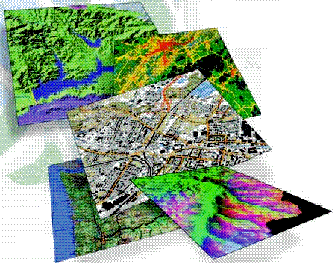
In the Wells Library there were posters of Geographic Information Systems (GIS) and satellite imagery and booths displaying campus GIS information, courses and resources. The event showcased available jobs and careers, GIS training and certifications, and how GIS technologies can affect the way we view and analyze our environment. GIS professionals has booths detailing GIS mapping applications, satellite imagery, library science, environmental information and geocaching activities. Posted up on many large cork boards were satellite images. There was a game set up where people had to guess the location of the satellite image. I did not many of them but being from Washington D.C. I guessed that one right away.
I collected a lot of good information on GIS courses and about the software the library has. I intend to take a GIS course next year and this was a nice event to get some background information. I have taken an introductory GIS course in college but I would like to be well versed in in the software and applying it to real world situations. The use of GIS has increased rapidly and are in use for most development plans. Some examples for GIS that I am interested in for on conservation efforts, studying species habitat and studying tree loss.
Chapter 14 of Roseland: Tools for a Sustainable Community
This chapter discussed the many planning and assessment tools to move towards a sustainable community. Some tools can be conducted at the local level by citizen groups, but some need to be utilized at higher levels such at the government level. The search conferences under the community planning tools seemed to be described as similar to a charrette. I think it would be beneficial for BCOS to hold a charrette or a search conference to formulate a sustainability vision for Bloomington. Once a sustainability vision was formed BCOS will have set targets, goals and can establish projects from grant and government money to achieve them.
Roseland mentions many useful technical tools such as an ecological footprint analysis, environmental space, community based state-of-the environment reporting and sustainability reporting. An ecological footprint analysis of Bloomington will inform us to what extend of a negative impact Bloomington has on the environment. The analysis will also tell what areas (such as residential, business, government, food, transportation, energy) have the largest environmental impact. The ecological footprint analysis measures unsustainability by the degree to which the footprint of human activities exceeds the total productive area. This chapter holds great information for BCOS and the city government on tools and examples from other cities on community sustainable projects. We have utilized some of these tools in class such as the SWOT analysis. Bloomington have made some community sustainability efforts and tools that this chapter mentions such as an environmental audit, with the upcoming community household energy audit event. As well Bloomington has used the technical tool of an environmental impact assessment through the publication of the Peak Oil Report.
Wheeler: Visions of Sustainable Community
This was an interesting and section of the book, where the readings were author's visions of the future and how the world will be the effect sustainability and the sustainable movement will have on communities. I liked the visions for most of the readers but the way in which Wheeler connected people's drive to be sustainable and eco-friendly to religion was strange. I thought is especially weird that he made up a future religious figure, Pope John XXIV or the "Green Pope." Other then that Wheeler's vision of the 23rd century was quite entertaining. I was glad to read that we had not all died in the apocalypse of 2012. I think it was feasible to predict that we currently did not act fast enough of take the necessary pre-cautionary actions to prevent the affects of global warming. I was expecting more exciting technology like the ability of beam ourself to different locations so cars of car-like vehicles would not longer be in use.
I was impressed with Callenbach's vision of Ecotopia because from writing in 1975 he actually envisioned many things that are currently in effect. I have never been to San Francisco after this reading i really want to go and hope it its as lovely, sustainable and bike and pedestrian friendly as Callenbach's vision. I do know that San Francisco has an excellent public transportation system utilizing all mediums such as trolley cars, subway and bus. I don't think that SanFrancisco has car-free zones but there are some cities that do, such as in Austria, Germany, Denmark and Greece. Personally i wish that all of the old electric trolley cars would come back into cities. I know there used to be a trolley system in Philadelphia which has practically died out. There are a few trolley routes left in the city but not many. the trolley's would reduce cars on the road and reduce use of oil from cars and buses.
I found this super cool video about a future green and sustainable city that is currently being build called Masdar City. It is a planned city that is being built by Abu Dhai Future Energy Company, a subsidiary of Mubadala Development Company, where the majority of seed capitol is being provided by the government of Abu Dhai.
There is a video about the city have is short but i couldn't get it embedded into the blog. But you can click on the blog to view the video.This video is around 3 minutes. Masdar City Video
Or you can view the 6 minute video below:
I was very impressed with the speeches and the Poster Session in the IU Memorial Union. I liked the how IU and the Office of Sustainability have 20 goals to be reached by year 2020. From the University's support and all of the internships efforts I think that IU can come very close to achieving those goals. The combination of modern dance and poster presentations was a new and interesting mix. I enjoyed looking at the posters from other classes and seeing the work they had conducted. I feel there was a good turn out and several people came up to ask us questions about our poster. Many where interested in the renewable energy opinions Bloomington and Indiana has a whole had. To add to our poster we had on our table small-scale examples of a photovoltaic array and solar hot water heater. These objects helped draw people to our poster and many had questions on how the solar hot water heater worked. It was so nice to see all our group efforts come together and represented through our poster.
From last thursday class when we presented our powerpoint and poster in class to the BCOS representative I felt that our project was really meaningful. The representative from BCOS seemed excited and interested in our project and the recommendations we made on potential targets for indicators and actions to lead towards our suggested targets. The BCOS representative enjoyed each presentation and wanted to send our power points to her to share the classes insights and projects with the rest of the BCOS members. I hope that we will see our recommendations put to work in the next STAR Report or through the next BCOS energy initiatives. I was unfortunate that only one BCOS member was able to come to our class. But our power points and posters will be give to BCOS at their next meeting.
I was watching the Rachel Maddow Show last night. Rachel was interviewing Robert Frank, an economist from Cornell University, and discussing the issue of the lack of jobs in the US. He was saying that the reason that there are so few jobs and lack of job creation was due to the fact that people were not spending enough. Since people were not spending and the economy is not improving, companies have no reason to expand and hire more workers. I was surprised that the economist was saying that the solution is to spend more when we have discussed in class that overconsumption is the cause of your current environmental and economic problems. The lack of jobs is a serious problem and I am worried about all of us once we graduate because the economy and the availability of jobs is not going to change that fast.
Government and Governance mean to different things. Government is centered around delivering services and keeping order. Governance is about leading society, spurring people together to work towards common goals. The ideals of a sustainable community can be put into reality through governance.
I have a personal story about an example of governance that promotes a sustainable community. There is a group in my hometown called the Little Falls Creek Clean Up which my mom is a member of. This groups promotes the health of the Little Falls Creek that runs through out the neighborhood. The group hold Creek Clean Up days and is active in restoring the banks, removing invasive species and planting native plant species. The group is an act of governance by promoting conservation, restoration and a healthy neighborhood. The creek clean up days have become very highly attended and is now a large social event. The Little Falls Creek Clean Up acts a guide to show people what actions benefit the community, such as picking up trash. This group and it's members are public participants that are critical more creating a sustainable community. We need to combine ideas with action to have a successful sustainable community.
America today has many problems, one of which is the fact that our industry is operating in the same as it's been since modern industrialism. During modern industrialism there were fewer people and plentiful natural resources. Due to the successes of industry and capitalism during the industrial revolution it has lead today to a situation where things are reversed. Where today there are more people and fewer resources. Industry is still operating by the same rules that worked during modern industrialism, by using more resources to make fewer people more productive. This results in creating huge amounts of waste of resources and people. Natural capitol is being destroyed by industries because historically industries has benefited by doing so. We need to change the manner in which industries function to account for population growth and the depletion of natural resources.
One way that we can change the behavior of industries and the way in which markets and our economy functions is to create prices and markets on the environment. Environmental resources have no market, meaning they are not bought and sold. With no market on environmental assets we see that economic activities downgrade the environment and sometime ignores it altogether. In general with the absence of price, zero price or when things cost nothing to the user they tend to be abused. This can be seen as with the tragedy of the commons. Having markets for environmental assets will create incentive for people to maintain natural resources, nurture the environment. Once the environmental and it's assets have prices attached to them people will take good care of the them in order to sell their assets and make a profit. Since no one would want or could use a degraded environmental asset.
As our population grows we are developing more, meaning more land will be overtaken by pavement, more people will will jobs, places to live and food. All of theses personal needs is part of what economic development is trying to generate. Currently economic development in the US is run by our economy by focusing on growth, global trade and currency. An alternative to this is sustainable community economic development (CED) is focuses on development, people and ecosystems. The emphasis of CED is on social equity, environmental responsibility and increasing local economies. Bloomington is instilling a local economy by having local non-chain businesses/restaurants, holding a farmers market, having food co-ops and having a local and organic grocery store (Bloomingfoods).
From a Culture of Consumption to a Culture of Conservation:
I went to the public lecture where Scott Russell Sanders spoke about one of this books "A Conservationist Manifesto" and about the current consumption of the United States. In Sanders book he talks about underling cultural and economics ideals that lead to our current situation and how lead towards a conservationist future.
Main challenges in US:
Climate disruption
Loss of biodiversity
Loss of arable lands
Pollution and scarcity of fresh water
Pollution and depletion of the oceans
Exhaustion of key material recourses
Loss of ecosystems services: photosynthesizing, soil fertility, water. Sanders told me of some unsettling facts:
-The loss of 80% of big commercial fishes. -There is 10 times as much plastic as much plankton.
-Species extinction 100 or 1,000 faster then the last mass extinction time of the dinosaurs.
Is our consumption accidental? That may not be so due to the quote below:
“Our enormously production economy demands that we make consumption our way of life that we concert the buying and use of goods into rituals that we seek out spiritual satisfaction our ego satisfaction in consumption. The economy needs things consumed, burned, work out , replaced and discarded at an ever-increasing rate” (Victor Lebow The journal of retailing 1955)
Sanders reply to this quote is a task and target for the US to work towards to change from being an consumptionist to a conservationists. Sander's Key task for the US is to dramatically reduce the rate of extraction of materials from the Earth: oil, coal, metals, minerals, etc. and to dramatically reduce the amount to waste, toxins, and green house gases dumped into the soils and waters and atmosphere. We should aim at zero throughout and zero waste.
Wendell Berry preaches and I agree with this sentiments. Berry emphasizes that once the land is destroyed the rest of our country, economy, lifestyle will crumble. We depend on the land for our livelihood to access food, shelter, energy and clothing. From the necessities we extract from the land we have created our present world with our lavish lifestyles and advanced technology. As well we are dependent on oil and other natural resources and minerals from the earth. We cannot continue our way of life and still expect to live in the fashion that we do. Our country/land is being destroyed through many venues, some examples are: mining, mountaintop renewable, soil erosion, water and air pollution, deforestation, logging, litter, urban sprawl.
We are being pressured to help the economy by spend more on things that are generated by destroying the land. So we are ending up in a vicious cycle of our economy being down due to the land being destroyed, then government pushes people to spend more to build up the economy but what we buy destroys the land so we are back in the same predicament.
It was a honor to have Wendell Berry in our class, I enjoying hearing his views on current issues. I like his idea that sustainability was once called thrifty, and should focus on making things last as long as possible. I feel that my family it still thrifty or cheap in some way being sustainable. I am Jewish and there is a stereotype that Jews are cheap and it usually have a negative connotation. But after hearing Berry speak being cheap or thrifty should not be a negative thing, but viewed as way to conserve.
In class we have been discussing what makes a sustainable community and have viewed many types of communities, and the issues centered around them such as amount of resources used, environmental and human health, pollution, waste. We have a lot thought about what a sustainability community environmental and for personal prosperity. For the environment a community should have such as utilizing renewable resources and not taking more from the land that can be replenished. On the personal side, its good to have communities that are walkable, with centralizing meeting places that foster connections and communication.
New ideas about how to form and build communities and housing developments are being generated. We have talked about some such as new urbanism and an urban village. Another alternative housing development strategy is co-housing. Co-housing is where residents actively participate in the design and operation of their own community. Co-housing communities consist of private houses with public/ common house can recreation center. Future residents participate and making their community to fit their needs. This leads to a tight nit community as people get to know each other over the course of building their community, I think co-housing is a great idea because then people and architects can work together to form an ideal community. Also the residents can set standards for the community such as the houses or public facilities be made sustainable such as with used and recycled materials. Or high efficiency products and amenities can be implemented to the houses to reduce energy usage. Co-housing accommodates people with varying income such as some houses in the community can be shared housing. I think that co-housing should have specific themes or ideals, that future residents have to keep and mind and uphold while developing their community. Such themes or ideals could be having LEED buildings, carless community, or using renewable energy sources.
I think co-housing is a great way to foster community and a sense of place. Since the residents help build the community they will have a sense of ownership about it can take care of it. I think one of the best features of the co-housing is that you will know your neighbors. Whether you live in the city or suburbs without a sense of community, even though you are surrounded by people you fee alone. From experience growing up in my neighborhood, I hardly new anyone in my neighborhood, and for that matter on my street. I knew the people who leaved to the left and right for me, but not the people across the street. I think due to the lack of shared common areas or facilities or the lack of community itself lead to me growing up no knowing my neighbors. Today it is a bit different because I live in an apartment complex with a high percentage of SPEA graduate students. I leave in fountain park and know about 8 people in the complex. I have gotten to know then in just around 3months. Compare that house I grew up in, in which after living there for 18th years I think I knew 8 or less people in my neighborhood.
Sumner is the name of the neighborhood i grew up in, which is located in Bethesda, MD. I only just today found this website for the neighborhood to see how it tried to make Sumner a community. I was curious to know about how my own community compares to what we have been discussing in class. To me i think the main barrier is my community is the lack of communication. Alternative housing/community development should think about how to foster good communication among neighbors and other community members.
Here is a picture of my house to get a feel for my community:
Reading: Roseland – Chapter 10 – Land Use and Urban Form
Reading: Wheeler – Land Use and Urban Design (pp 87-111)
Transportation and Land Use are related, the form of transportation people use reflects the how the land or build environment was constructed. Take for example the dead worm suburbia subdivisions where there are lots of end end streets, no grid and not all streets connect. It is impractical for buses to be weaving around in subdivision so there are usually no buses that go out to many suburban areas, resulting in people owning and driving personal vehicles. If theses suburban areas were constructed differently maybe buses could go through them and have less people driving to and from cities. Sprawling cities and places with sprawling urban development is an inefficient use of land and promotes the use of cars and personal vehicles. New Urbanism is emerging to combat sprawling areas. New Urbanism is a set of planning principles to have walkable, affordable, transit-oriented neighborhoods. I also like the idea of urban villages that Roseland mentions. The term urban village to me means having a suburban-like feel within the city the emphasizing minimal car dependence and high use of rail/ public transportation systems.
Suburban sprawl increases pollution, decreases inner-city development and generates huge costs. A great form of land use is mixed-use zoning to have food, residential and offices all intermingling. This will increase intensity of land use and ideally minimize private transportation. Along with mixed-use city planners should think about where they place key buildings such as schools, churches, stores and shopping malls. Ideally all theses places should be walkable to a majority of city residents. Like the term from Wheeler that Calthorpe use which is Transit-Oriented Development. Personally, since i grew up there, I think that Washington D.C does a tremendous job of land use that is transit-oriented.
We live the majority of our lives indoors, breathing stale air. This because we have walled ourselves in houses, office buildings, schools, religious centers, cars, and the list can go on. A main thing that is lacking in more neighborhoods and cities are centralized green spaces and meeting areas. This can bring nature into the cities and give people a breath of fresh air.
Before the reading I had not heard of the term "infill", which means the construction of new housing, workplaces, shops and other facilities in existing urban and suburban areas.
A major roadblock that I see with trying to re-develop or re-consturct sprawling areas in to urban villages or new urbanization neighborhoods is that what do we do with all of the people that are currently living in the sprawling subdivisions. We can't force everyone to move out, yet we want to get rid of these sprawling areas. Once these new urbanism and urban villages are created, i wonder if the government can give subsidies or other incentives for people to move back towards the city. This way the sprawling neighborhoods can revert back to natural environments or be used for agriculture.
There is a documentary called Subdivided by Dean Terry that talks about the issues of Suburbia. Below is a trailer of the movie:
I went to the Themester Event on Renewable Energy Development in Indiana. Program Manager over Renewable Energy for the Indiana Office of Energy Development (OED), Travis Murphy gave the presentation. OED- Office of Energy Development: is the Indiana state energy office, responsible for Indiana energy policy development and implementation as an arm of the Lt. Governor’s office. Hoosier Homegrown Energy which is the state's strategic energy policy. This policy leads state’s efforts to develop alternative fuels, clean coal technology, and a variety of other renewable technologies including those derived from wind, solar, biomass, geothermal.
Currently Indiana is heavily dependent upon “cheap” coal for energy. Vast resource locally (500+ years) currently import over 49% as a result of sulfur-rich composition of local coal.94% coal fired electricity. Indiana also has an energy intensive economy, particularly electricity.Summer electricity demand in 208 was 27079 MW includes buffer (EIA, 2008).Resulting from an economy based on manufacturing, casting, forging, agriculture, distribution.
Renewable energy has a lot of advantages environmentally, socially and economically. A key advantage is that using renewable energy will have reduce the need for importing energy. As stated above Indiana import 49% of their coal. Other advantages are it will reduce our dependence on oil (fuel), provide more job opportunities and will not degrade the environment.
Indiana is in a great location to utilize wind power. This based on the fact that Indiana has the 14th best 100m wind resource in US. Indiana receives a lot of high winds, and Indiana has the capability to sell their wind energy to other states such as Washington D.C. and other east coast states. Indiana currently has 1139MW of utility-scale wind online, equaling to 800 turbines. The OED should be working with Duke Energy to get then to utilize wind power. Some electricity company's give options to have a certain percentage of electricity to come from wind or solar. Duke does not have that option, but I think it would make Duke more competitive and more likes by the public if they do link up with wind or solar power.
Indiana is also utilizing Biofuels in the form of Ethanol, Biomass, Solar, Hyro, Geothermal. Personally I think utilizing used vegetable oil, and grease as biofuel is better to use then ethanol. I asked Mr. Murphy if Indiana was utilizing vegetable oil and his reply was that there is not enough to do on a large scale. But there were local projects going on where restaurant waste oil was collected, turned into bio fuel for buses. On a large scale ethanol is apparently more practical. Currently Indiana has 12 completed Hoosier ethanol plants. 11plants providing 938 million gallons of ethanol annually. Indiana is the first in the country to create a biofuels corridor of pumps for E85.95% of our convenience stores are blending ethanol with their gasoline (E10); E15 recently approved through EPA for ’07 current vehicles.
Our project has been slow to start due to struggles working with BCOS. Initially we were going to update the BCOS STAR Report's energy section, by updating information and assessing the indicators used. There as a lack of accessible information for us to update the indicators, and after we have already conducted research and established recommendations for the STAR Report Indicators BCOS announced that they were going to chance their indicators to the ICLEI Indicators. So our updated STAR Report was forgone and we turned our focus onto the ICLEI Indicators. ICLEI stands for Local Governments for Sustainability.
Our current Energy Project Initiatives and Questions we plan to answer are listed below:
1. Energy Inventory
2. ECLEI review: setting targets. This needs fleshing out. Get to know ECLEI? Which indicators can we address?
3. How do other communities set targets and measure success? Are there communities with an energy plan for the future? Communities that address peak oil?
4. Recommendations to meet targets. Grants. What is Duke willing to do? Funding opportunities for renewable development, can possibly be broken down by energy source
I think that the United States is not only oil dependent but car dependent as well. The two go hand in hand that since oil used to be cheap American's could afford their own car and then people craved the independence that goes along with your own personal car to drive whenever and where ever you want. Transportation management and congestion are a major issue for cities. Traffic causes environmental issues with air pollution, health problems one example being asthma, and social stress from commuting long distances to work.
Another reason we have become dependent on cars is due to how we have created our build environment. We have not been every wise city planners, with sprawling cities and outlining suburbs. People living in the suburbs need to drive cars if the city's public transportation system doesn't go that far out. As of 2000 from the Roseland book, 88% or daily commuter use private vehicles and less then 5% of all commuters travel by public transportation. If we centralized housing and have extensive mass transportation maybe people will feel the need to drive less. To centralize housing, and have it be in the cities we need to have affordable housing in cities. One reason that people move farther and farther out of the cities is that land and housing is cheaper.
The Bloomington has several good reports and plan on how to improve transportation in Bloomington. In particular I like the Bicycle and Pedestrian Transportation and Greenways System Plan. I am excited for the B-Line trail that is currently underway, that is connecting bicycle pathways. The B-Line trail will connect the Bloomington Rail Trail and the Clear Creek Trail to have a connected bike path through downtown Bloomington and into the surrounding areas. If your interested you can get information on the B-Line trail at this link: B-Line Trail
I think that Bloomington is well on their way to being a sustainable community but still need improvements in transportation. I think that the bus system should be extended or have the bus system and another mass transit system such as the use of trolleys using electricity instead of gas. One idea to get cars off the roads is to install a trolley or some mass transit system and not allow cars within downtown Bloomington. This could lead to having less congestion, car accidents, and have the city be more walkable and bike friendly.
I am fortunate to live only a mile away from IU and have a choice between riding my bike or taking the bus. I live on the east side of campus off of 10th st. I have had a great experience with the bus system but I know of some friends who live further out who say the bus isn't reliable. I would like the bike path that I take to be improved. From the intersection at Pete Ellis and 10th st. I take a bike path that is right next to the railroad, the issue with the path is that is leads you to the By-pass with no crosswalk. So I have to wait for there to be no traffic on either side of the street and you know that hardly ever happens especially around rush hour. I heard proposed plans that a tunnel was going to be built there for bikes to go under the B-Pass, which would be pretty cool.
Last weekend I was visiting my boyfriend who goes to the University of California in San Diego. He lives in the newly constructed Rita Atkinson residential hall which is LEED Silver certified. After all the reading and discussions we have had on LEED and green building it was interesting to view a LEED Silver Building. While I was there I did not see all of the LEED features of the building, but the building does have a green roof.
The building may have gotten all of the LEED certification points but it missed the mark on the purpose of the build which was to provide apartments to graduate students and other professionals. The interior of the building is very unattractive and depressing because you can still see all the cement and duct work. No one took the extra effort to paint the walls. I think the theme was trying to be minimalist and modern but it was not a good idea for a residence hall, because you want a home-like fell to where you live, not to see cement walls like your in jail. I wish this building project had know about the Living Building and the "petals" criteria because the beauty petal was what was missing.
Class Discussion Topics: What was Bob Berkebile’s contribution to green architecture? What is a Living Building? What is the baggage that David Orr is referring to? How does that relate to your life and the design of communities and buildings?
Reading:"Hyatt Regency skywalks designer Bob Berkebile is the godfather of green building" Berkebile have contributed a lot of green architecture. He chaired a Committee on the Environment for 2 years and published the first Environmental Resource Guide in 1992. Buildings are one of the highest consumers of electricity and resources. With in the US buildings use 70% of the nations electricity, 30% of the nations raw materials and make 30% of the nation's waste. Berkebile pointed out that green-building does not have to be more expensive, since we can utilize free energy sources such as the sun. A big contribution that Berkebile did for the green architecture movement is in 1993 was to help create the U.S. Green Building Council. This council is very influential today for green building, which is committed to sustainable building design and construction. A great thing that have come out of the US Green Building Council is that they developed the LEED building rating system. Berkebile has his own firm BNIM which is one of the leading environmental design outfits.
Reading: "First Living Building Challenge winner" (by Berkebile’s firm):http://tinyurl.com/2fl2ghw The winners of the Living Building Challenge was The Omega Center for Sustainable Living in New York and the Tyson Living Learning Center in Missouri. From what I gathered from the reading the criteria for the Living Building Challenge was similar to the LEED rating system but each criteria was called a "petal." A cute themes to have that a living building should connect and be related to something living such as a plant. The "petals" rating topics covering site, materials, energy, water, indoor quality, beauty and inspiration. The Omega Center has a very cool way of reusing water and gray water by use a Eco Machine. The Eco Machine is a living systems that uses plants, bacteria, algae, snails, and fungi to recycle wastewater, clean the water that is then used to restore the aquifer.
Living Building/Architecture
Reading: "Baggage: The Case for Climate Mitigation: David Orr: http://www.davidworr.com/files/CB-62%20Baggage.pdf The baggage that David Orr is referring to is all of thing that we cannot fix. Even if we try our best now to slow down of stop climate change there will be species, ecosystems and coastal cities will be lost or dramatically altered. We have to carry those results and that baggage with us into the future. Hopefully this baggage will make us be more precautionary and wiser about our future actions. We need to keep David Orr's thoughts in mind so that when we design future communities and buildings they will not contribute to climate change.
On the Topic of Climate Change I think that topic has been so slow to catch on is that if it is true that we are irreversibly altering the planet, that the equilibrium of the earth and all it's natural processes can't continue and be sustained humanity and all life are doomed. This is a harsh reality that people just don't want to think about. I think it's ironic that usually the more spirited, driven and upbeat people who want to protect nature, end up discussing depressing topics about everything that is wrong with the world. It brings a kindred spirit down when talking about acid rain, smog, oil spills, deforestation, water dead zones, bleaching of coral reefs, endangered species, poaching, climate change, and the list goes on and on.
If you interested to know Americas 10 worst man made environmental disasters you can click on the Link
Reading: Reseland Chapter 8: Atmospheric change and air quality Wheeler p.174-180
Discussion Questions; How do air pollution and climate change intersect? What might be the effects of climate change on Indiana? How might we mitigate those effects in sustainable communities? How do we adapt to those changes we can’t mitigate? Which of Pacala and Socolow’s “Stabilization Wedges” relate to sustainable communities?
Air pollution and climate change intersect because the chemicals and pollutants have we put into the atmosphere cause climate change. Human activities release atmosphere pollutants in two main phenomena smog and acid rain. Smog is produced mostly from the combustion of fossil fuels from things from cars and factories. Acid rain is caused by sulphur dioxide from cement works, oil refineries and other industrial sources. There are many attributers to Climate Change that can be seem by the graph below.
The attributer that is increasing the fastest at an unsustainable rate are the greenhouse gases. Greenhouse gases such as methane, carbon dioxide, nitrous oxide, and flourocarbons are naturally occurring gases that absorb solar radiation. Humans have become a main contributor to the increasing amounts of greenhouse gases due to admitting large amounts of these gases, in particular carbon dioxide. The use of fossil fuels from car emissions, to factories all release carbon dioxide to add to the green house gasses in the atmosphere to increase the heat retention in the earth's atmosphere.
The Stabilization wedges and triangle that Pacala and Socolow talk about are necessary but I think is unrealistic due to currently rate at which we burn and admit carbon dioxide. They estimate that to remain at a stabilization point of 500ppm requires that emissions stay at the current present level of 7 billion tons of carbon per year for the next 50 years. The problem is that we are currently on course to double that figure in he next 50 years due to population growth and our consumption rate of fossil fuels. The categories that the article presents are good goals and initiatives for sustainable communities to carry out. Such initiatives are to decarbonize and wean ourselves from fossil fuels in particular coal, focus on efficiency and conservation and utilize natural carbon sinks.
Indiana's (Bloomington in particular) main source of electricity come from coal, which when burns results in carbon emissions. Seeking alternative fuel resources instead of using coal is the best thing Indiana can do to reduce their carbon output. Indiana is suffering from climate change as the summers get increasingly hotter which leads to droughts and alters food crops. We are currently in a drought that can be seen at the water levels of lake Griffy and Lake Monroe. Climate Change could have serious affects on agriculture and water supplies. Relating to the hot summers also causes negatives health affects such at heat stroke.
Wheeler Green Architecture and Building p. 253-273
Discussion Questions:
Buildings are by far the largest energy user, especially of electricity. What can we learn from the past to inform modern green buildings? What makes a building green? What can cities do to encourage green building practices?
We have forgotten from past generations the knowledge of building designs which fit the context of our enviroment. Before humans developed the technology to utilize fossil fuels, we constucted builds that utilized the natural elements such as the sun. Such exampleas can be seen from the Greeks and Bedouins. Both utilized the motion and strength of the sun by designing structures to either capture the sun for heat and insulation, or block the sun to get shade and cooler temperatures. Not just using the sun but also wind and water, by constucting building to funnel wind in to cool the area and to collect rain water. Since fossil fuels desgining is not connected to natural element but instead relying on modern technolgy such as heating and cooling systems and electricity. We need to integrate modern technology with the historcal form of design to have technology work with the natural elements. Such examples are to have south-facing windows specifilly located to capture light and to warm the house. Can implement solar panals and solaw hot water systems to lessen our use of fossil fuels.
The article by Vale had some principles to green building and what makes a green building. Some of the main principles that comprise a green building are listed below:
1. Building should be constructed to minimize the need for fossil fuels
2. Building should be designed to works with climate and natural energy sources
3. Building should be designed to minimize the use to new resources
LEED (Leadership in Energy and Environmental Design) is a green building certification system developed by the US Green Building Council (USGBC). The system is based on a numerical rating system in which you get more points for the more green or sustainable, energy efficient, recycled materials requirements that the building incorporates.
Looking at the USGBC Local Branch website I found that the closest local USBG chapter to my hometown is the National Capitol Region Chapter. I am from Bethesda, MD but since I leave so close to Washington D.C I am closer to the DC national Capitol chapter then the MD chapter. In MD there is the Northern Chesapeake Branch which is part of the Maryland USGBC Chapter.
Incentives: are huge motivates to get a desirable form or action, response or behavior. Incentives are a good community based social marketing tool.
One effective incentive that is used often are financial incentives either by implementing fees or my providing a monetary gain.
An example of fees can be seen in the case of waste reduction where cities implemented a charge for the amount of waste set out on the curb. An example of monetary gain is when you can turn in recycle plastic bottles and aluminum cans for cash.
Two forms of incentives to promote energy efficiency in residential homes: Once is to have alterations to the price of energy the other is to have financial incentives to make a home more energy efficient. An incentive example to promote reducing energy use is to have higher energy rates during peak hours.
Transportation Incentives:
Theses are incentives that promote driving less, not at all or taking the bus or carpooling. An example of Carpooling is having the HOV lanes on highways. If you carpool then you don't have to sit in traffic during rush hour.
However in the US in comparison to other countries there are incentives where driving is the best option. Such incentives are that price of gas has remained low, Us have invested in highway construction to make is easier for people to drive and live long distances form work. The third incentive is that interest on mortgages is tax deduction providing incentive for people togo live in the suburbs where they need to drive to work into the cities.
Creating Effective Incentives:
Closely pair the incentives and the behavior
Use incentive has a reward for positive behavior
Make incentive visible
Be cautious about removing incentives
Prepare for people's attempts to avoid the incentive- try to predict how people will try and avoid incentive
Consider size of the incentive: needs to be large enough to be taken seriously
Consider non-monetarty forms of incentives
Roseland Chapter 7 Energy Efficiency and Renewables
The United States uses more energy per capita than any other nation. What are the outcomes of this “addiction” and what can be done in sustainable communities to turn this around?
The environmental impacts of our high energy consumption lifestyles include ozone layer depletions, acid rain, smog, climate change, other forms of pollution and environmental degradation and habitat loss. Our "addiction" to energy is also seen in society with congested roads, urban sprawl, Heat Island Effect, costly inefficiencies in commercial and industrial equipment, weaker local economics and excessive taxes.
Things can be done to turn around our current situation and go towards communities that use less energy which are not dependent on oil and fossil fuels . Citizens and their governments have a ton of power to change current patterns of consumption in two main ways:
-By being energy wise and altering individual behaviors. A large collective amount of individual behaviors equals huge impacts. I got an example of this from the Energy Star website "If every home in America replaced just one incandescent light bulb with an ENERGY STAR qualified CFL, in one year it would save enough energy to light more than 3 million homes. That would prevent the release of greenhouse gas emissions equal to that of about 800,000 cars" (Energy Star site).
-By governmental policies that promote green energy and energy efficiency. This can be seen in several different ways, the government could have rebates for people to get energy efficient products or government could invest in buying green energy.
I learned a new term form the Roseland chapter, "economic multipliers," which is situations where people save money on things that are to business or companies outside the community and instead re-invest the saved money back into the local economy that circulates several times over.
Renewable energy technology is still more expensive then our conventional methods but is getting competitive and more prevalent. Renewable sources of energy can be seen through solar, wind, water, biomass and geothermal. We can get solar energy through photovoltaics or solar thermal energy, water from micro-hydro systems, and biomass energy comes from agricultural plants or organic wastes that we can use as fuel such as bio fuels.
Fun Fact for today: October has apparently been declared National Renewable Energy Month!! You can check out the article about it: www.reuters.com
After reading the two articles US is far behind other countries with altering our waste processing stream to be more sustainable. Both Girardet and Lyle discuss how humans are using linear systems on a world who's ecosystem functions on a circular fashion. The articles both have the similar mentality as the Cradle to Cradle book, which is that outputs need to be inputs as well. One big issue is sewage which is being released into rivers and oceans to pollute our water that we then need to treat to make drinkable again. A more efficient sewage system the article by Girardet mentions is to have a recycling facilities where sewage can be treated to have the main output be fertilizers for farms. This is currently being done in Bristol where the water and sewage company dries and granulates the cities sewage. Other ways to but wast back into they natural cycle is by biological re-assimilation through aquatic sewage treatment and composting.
The way we use energy is unsustainable as oil levels deplete. One reason that alternative energy sources have not caught on it due to the price. Sola energy is about 8 times more expensive then current conventional sources. But there a lot up and coming alternatives to fossil fuels, such as CHP (combined heat and power) stations, heat humps, fuel cells, photovoltaics.
I have grown up learning the "3Rs" and I feel that I have have been doing my part to reduce waste. However the 3R's are not the only way to reduce our waste and are not enough. The goal is to not produce as much waste in the first place so we don't have the issues of how to dispose of it all. I was surprised by the fact in Roseland that said "most waste production originates in the manufacturing and distribution phases of production of consumer products. Therefore opportunities for source reduction in municipal solid waste begin before produces are even manufactured." This is one main reason why people need to think more before purchasing items. Personally I'm all about bargains and sales and tend to shop at thrift shops. There are many good products that can be bought that are not brand new, we can conserve and reduce our consumption by extending the life of products by reusing then or giving to charity for others to reuse. Such organizations include Goodwill, Salvation Army, Plato's Closest, and Second-Hand Book stores. In Bloomington the Hoosier to Hoosier Annual Community Event is a great example of reuse.
Roseland sub-sections the chapter into the ways we can decrease the amount of waste that enter the waste stream to be either sent into land fills or incinerated. The ways are to Source Reduction, Reuse, Recycling, Recovery, and Composting. On the idea of composting, many companies now aways are trying to make their products or the packaging of their products bio-deradable. This is a good idea because then the packaging don't remain in the landfill for all eternity. But it still is filling up the landfills because it takes years for it to fully biodegrade. It is easier to have less packaging in the first place. I get so aggravated with packaging for many products, they have plastic sealed the product in to well i need more then scissors to get it open!
I thought the Story of Stuff video we watched in class was very eye-opening. This was the first time I had watched it and I was impressed at how much information she packed into a 20 minute video. I was surprised by the conspiracy theory economists fashioned after WWI that spurred US citizens into being product consuming machines. Economists say that to boost the US economy people should spend more money so the recommendation for the President was to get people SHOP! With the on-slot of ads we have obeyed and are not consumption addicts. The video made me think a lot about me spending habits.
What is Water Conservation? Historically water conservation was in response to droughts and water shortage emergencies. Today it has expanded to be part of a long-term strategy to meet water demands, protect water quality and to be responsible and be wise about how to use a finite resource.
Bloomington has only one water source which is the Lake Monroe Reservoir. This means that the Lake and water use needs to carefully monitored, since it's the one water source we depend upon. I think the plan has a lot of good goals, focusing on economic incentives; government regulation; water management; alternative supply; and public education. Energy usage and water consumption are closely related and energy and water utilities should work together on conservation plans. A major current concern is how the drought is affecting the water level of the lake and what it will be mean for citizen's water usage. The drought has effected the water level of the lake but the water level decrease is more noticeable at Griffy Lake.
It was interesting to note the difference in water usage between the school year and then during the summer. There is a increase in water usage due to students. I didn't think about how big of an impact the school has on Bloomington as a whole. A difficult factor in dealing with water limits and amount the city regularly uses is that the population of Bloomington changes. The city "blooms" gets an influx of people during August and September and then the population declines during the summer months.
I noted like skimming this document that the Bloomington Water Conservation Plan talks about using water rates as a conservation tool to encourage residents and businesses to be water wise. Increasing water rates was one of the BCOS' water committee initiatives.
This is a not connected to the reading but I wanted to comment that, I have been boating out on Lake Monroe and after viewing the water all I can say is that we must have a very good water treatment/filtration facility, because the water looked pretty dirty and undrinkable (partly due to what I have seen fall into the lake). But that is not the say that don't drink tap water I do. I enjoy tap water versus bottled water.
In this chapter Roseland discusses the ways we have manipulated natural waterways (such as dams) and how we handle our sewage and re-use water. The main focus of the chapter though was discussing the may ways we pollute water and effectiveness of the systems we have to treat and clean the water. We pollute water with sewage from cities, agriculture and factories. Water is a renewable resource but we can cannot always use it like it is, especially in times of drought. There are many actions and behavior changes people can do to use less water. Some actions are to buy facet aerators and lo-flow shower heads because they will reduce the flow of water. A behavior changes are to take shorter showers (around 5 minutes).
Indiana is in a drought so we have to change how much water we use. Most water users pay a flat rate instead of payer per volume so they don't realize the actual cost of water they consume. The BCOS on the topic of water was planning on having the county increase water rates in Bloomington. I think the goal of increasing the water cost rate was to influence the amount of water people use and hopefully have people use less due to the drought. The drought in Indiana is causing the lakes and rives to dry up but it is also affecting agriculture and the dry fields can be a fire hazard. I read this new report about a farm in Indiana that went up in flames due to current drought conditions. Fire bans are currently in effect in several cities. Below ins a link news video report on a field fire.
This report goes into detail on the current status of wetlands and other bodies of water on earth, explains how wetlands are vital to humans well-being and stressing the importance of "wise use" of wetlands and water. I had not realized how much of a service wetland ecosystems provide use. Wetland ecosystems, including lakes, rivers, marshes and coastal areas contribute to human well-being and poverty alleviation. Wetlands ecosystems provide people with out basic needs of drinkable water and food (fish and other seafood) and water availably for agriculture, bathing, washing and cleaning. Earth would not be inhabitable without water so we need to keep our water ecosystems healthy so we can maintain our lifestyle and for the health of the rest of earth's inhabitants (flora and fauna). There are some major issues with humans degrading wetlands and other water ecosystems by pollution and land alternation (such as by farming and city infrastructure). It was interesting to find out that of the types of wetland ecosystems (terrestrial, forest, marine, fresh-water, grassland) the fresh-water is there most of the species are declining the fastest.
I received my undergraduate degree at Emory University in Atlanta, GA. During my junior and Senior year I worked at Atlanta's City Hall with the Director of Sustainability. My assignment during my senior year was to apply for the Green Communities Program and collect the necessary documentation to that the City of Atlanta could be certified as a Green Community.
The Green Communities Program is a voluntary certification program
The Green Communities Program is a voluntary certification program for jurisdictions in the 10-county Atlanta Region to encourage local governments to become more sustainable. ARC developed the program to assist local governments in reducing their overall environmental impact. Local governments earn points in 10 categories by implementing specific policies and practices that contribute to overall sustainability. The categories are:
Green Building
Energy Efficiency
Green Power
Water Use Reduction and Efficiency
Trees and Greenspace
Transportation
Recycling and Waste Reduction
Land Use
Education
Innovation
Green Communities set an example by conserving energy, investing in renewable energy, conserving water, conserving fuel, reducing waste and protecting and restoring the community’s natural resources.
Measures are worth 5 or 10 points, depending on their difficulty and overall impact. Three levels of certification are awarded:
Level 1 - Bronze: 175 – 229 points
Level 2 - Silver: 230 – 279 points
Level 3 - Gold: 280 – 400 points
The City of Atlanta did receive the Green Communities Program Award at the Bronze Level in 2009. I have added a video about the Green Communities Program on my Multimedia page. I think is it very relevant to this class at we define what a sustainable community it and what it would look like. This is an example of how Georgia defined what a green sustainable community should entail. Also in the Roseland book it discusses ways to move towards a sustainable community such as by government polices, tax incentives and voluntary programs. The Green Communities Program is an example of a voluntary incentive program.